Moog D633-525B, Fourteen Months Old: The Cleanest Hysteresis Our Bench Has Printed
Every bench develops a sense of scale. After enough sweeps you stop reading numbers and start reading distances — how far a hysteresis figure sits from the ones you have seen before. This record put a number on our screen that we had to look at twice: hysteresis, 0.10 %.
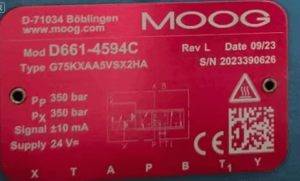
The valve is a Moog D633-525B, type R16KO1F0VSX2, serial 2025191878, revision G, nameplate date 05/25. The sweep was recorded on 26-07-14 at 15:33, which makes the unit roughly fourteen months old at test time — barely broken in. The numbers behave exactly the way a barely-used direct-drive valve should, and that is the whole story of this page.
What the plate says
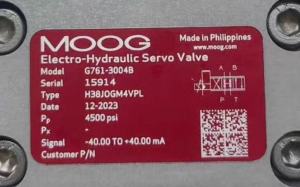
Read from our own photograph of the valve on the manifold, before anything was energized:

The serial prefix 2025 agrees with the 05/25 date field, which is a small thing but a useful one: on used stock, a serial and a date that contradict each other is the first sign a plate has been moved. These agree. The CE marking and the P-T-A-B port diagram sit below, and the DataMatrix code is intact — we photograph it on every unit even when we do not need it, because the day we need it is the day it is scratched.
The sweep
The static tester was set to a ±10 mA triangular command at 0.05 Hz, coils in series, coefficient 1, command on channel I1 and flow on channel Q1. One full cycle at 0.05 Hz is twenty seconds; the recording runs twenty-nine, settle time included. The curve the software drew — flow in L/min against command in mA — leans negative, saturates before the ±10 mA rail, and carries the narrowest null loop we have photographed on this bench.
Mid-sweep, the JT-IV console’s touchscreen showed 3.91 mA of command and 7.02 on its differential-pressure channel. We quote those two digits because they are legible in the footage and because they place the sweep in time: the valve was mid-stroke, loaded, and the panel was watching.
Rated conditions for the computation: 17.5 MPa and 10.00 mA. That pressure is higher than the 7 MPa we use for most records, and it matters for reading the flow figures — a no-load curve computed against a higher rated pressure puts more differential across the metering edges, so flows here are not directly comparable to our 7 MPa tables without saying so. We are saying so.
The numbers, as printed
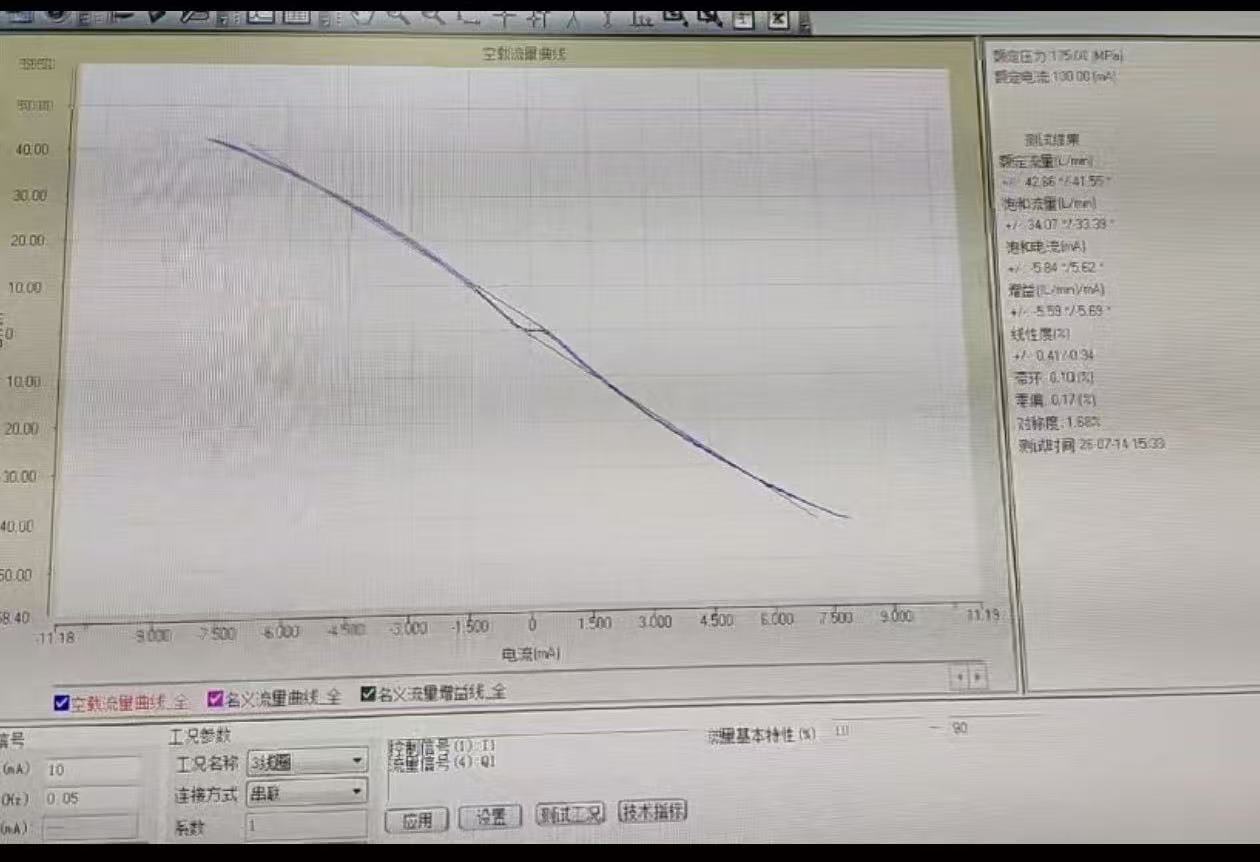
The stars are the software’s own marking, kept as printed; we do not know which limit table it checked that afternoon. Linearity and null offset came through unstarred, and at those values it is easy to see why.
Two sign and scale notes for readers comparing across our archive. The gains print negative here because this record’s channel mapping inverts flow against command — same physics as the positive-printing D634 record, different sign convention. And symmetry 1.68 % sits close to, but not exactly on, the gap between the two printed gains (about 1.8 %); the software carries more decimals internally than it prints, so we treat the relationship as consistent rather than exact.
Fourteen months against eleven years
We keep a 2014-built Moog D634-319C record from the same bench and the same software: hysteresis 2.20 %, null offset 5.15 % with the software’s star beside it, linearity near 7 %. Set the two side by side and the age signature is unmistakable.
The D633’s hysteresis of 0.10 % means the up-sweep and down-sweep traces lie almost on top of each other — the spool returns to where it was, every time, with essentially no friction memory. Its null offset of 0.17 % means zero flow happens at essentially zero command; nothing has drifted off centre. Linearity under half a percent in both directions says the flow-versus-command line is straight where it is supposed to be straight.
None of this is virtue. It is absence of wear. A fourteen-month-old valve that has seen light duty should post figures like these, and when one does, the record is worth publishing for the opposite reason our worn-unit records are: it calibrates the reader’s eye. If you are grading used DDV stock and your candidate posts hysteresis above 2 % and a starred null offset, you now know what the distance from new actually looks like on this bench.
One honest caveat: these figures describe the valve as it stood on 26-07-14 at 17.5 MPa. Static numbers do not promise dynamic behaviour, and a clean sweep does not certify the torque motor coil, the connector pins, or the internal filter screen. Those get checked separately, and when something fails there, we publish that too.
What this record does not include
No internal-leakage run at pressure. No step response or frequency response — static sweep only. No oil temperature entry: the bench panel has a temperature channel, but this record’s screenshot does not show it, so we will not invent one. The operating-condition dropdown label on the settings bar is not fully legible in the capture; the series wiring, coefficient 1 and channel assignments above are, and those are what the computation used. And the stars stay on the numbers they were printed on.
About the Tester
Marginal Hydraulic keeps this bench in-house in Guangzhou because we sell and refurbish what we test. Every servo, proportional and cartridge valve that crosses the plate, Moog, Parker, Rexroth, Vickers and equivalents, leaves with a static record: no-load flow, null leakage, and, where the job calls for it, pressure cycling up to 350 bar. Questions about any unit’s data or its availability: mailto:duffeng@marginal-hyd.com.
2026.10.06