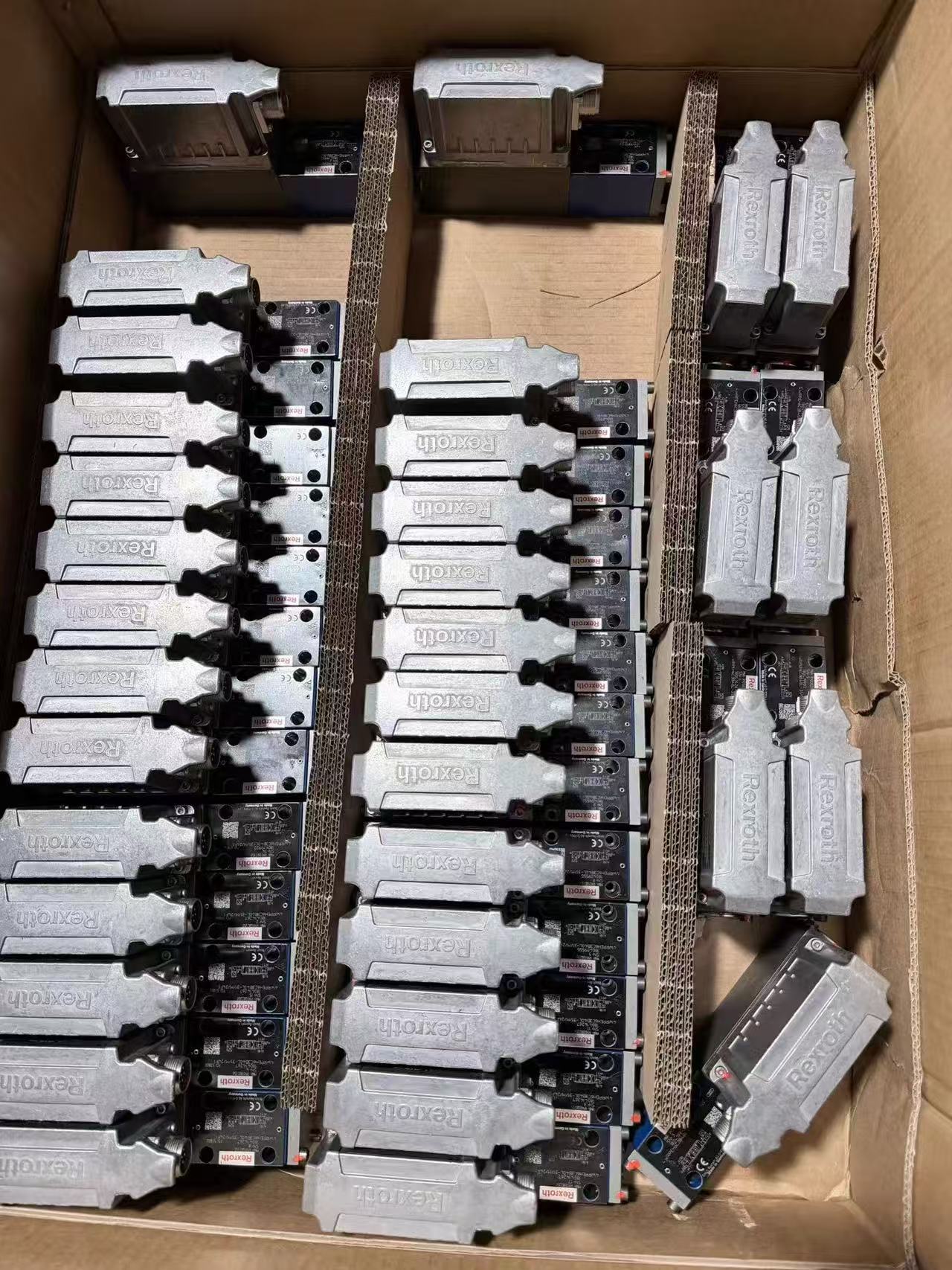
1. General & Mechanical Specifications
| Parameter | Size 6 (NG6) | Size 10 (NG10) |
| Valve Type | Direct operated, high-response | Direct operated, high-response |
| Mounting Pattern | ISO 4401-03-02-0-05 (CETOP 3) | ISO 4401-05-04-0-05 (CETOP 5) |
| Spool Position Feedback | Yes (Integrated LVDT) | Yes (Integrated LVDT) |
| Integrated Electronics (OBE) | Yes | Yes |
| Weight (Approx.) | 2.5 kg (5.5 lbs) | 6.8 kg (15.0 lbs) |
| Installation Position | Optional (preferably horizontal) | Optional (preferably horizontal) |
2. Hydraulic Specifications
| Parameter | Size 6 (NG6) | Size 10 (NG10) |
| Max. Operating Pressure (Ports P, A, B) | 315 bar (4568 psi) | 315 bar (4568 psi) |
| Max. Operating Pressure (Port T) | 250 bar (3625 psi) | 250 bar (3625 psi) |
| Nominal Flow ( = 70 bar / 1000 psi) |
2, 4, 12, 15, 24, 40 L/min | 50, 80, 100 L/min |
| Hysteresis |
|
|
| Manufacturing Tolerance |
|
|
| Response Sensitivity |
|
|
| Step Response Time <br>(Signal change 0 100%) |
|
|
| Fail-Safe Position | Spring-centered (if power fails) | Spring-centered (if power fails) |
3. Electrical Specifications (Integrated Electronics)
| Parameter | Specifications (Applies to both Size 6 & Size 10) |
| Supply Voltage |
24 V DC nominal |
| Voltage Range | 19.4 V DC to 35 V DC |
| Max. Current Consumption |
|
| Command Signal Options | A1:
(Voltage) <br>F1: |
| Actual Value (Feedback) Signal | matches command signal
or |
| Electrical Connection | 7-pin plug (DIN EN 175201-804) |
| Protection Class | IP 65 (with mating connector correctly mounted) |
| EMC (Electromagnetic Compatibility) | EN 61000-6-2 (Interference immunity) <br> EN 61000-6-3 (Emissions) |
4. Environmental & Fluid Specifications
| Parameter | Specifications (Applies to both Size 6 & Size 10) |
| Hydraulic Fluid Type | Mineral oil (HL, HLP) according to DIN 51524. (Other fluids like HEES, HEPG on request) |
| Ambient Temperature Range |
|
| Fluid Temperature Range |
|
| Viscosity Range (Recommended) |
(cSt) |
| Viscosity Range (Max Permissible) |
(cSt) |
| Max. Permissible Fluid Contamination | Class 20/18/15 according to ISO 4406 |
📌 Additional Notes for Selection:
-
Spool Symbols: Commonly available with symbols C, C3, C4, C5 (Closed center, linear or progressive flow characteristics).
-
Reference Datasheets: For complete performance curves (Bode plots, flow limits), please refer to official Bosch Rexroth datasheets:
-
Size 6: Datasheet RE 29035
-
Size 10: Datasheet RE 29037
-


📦 Warranty&Reture Policy:
🛡️ 1、One year warranty. If the product malfunctioned under proper usage per instructions manual within the warranty period, please contact us to obtain shipping instructions and send it back at your shipping costs.
🔍 2、14days evaluation and investigation takes placed after receiving your return item.
❓What Is a Proportional Valve?
A proportional valve is a hydraulic valve where a coil-driven solenoid pushes the spool directly in proportion to the input current.
🔍Key Characteristics:
- Higher flow than a servo valve
- Lower bandwidth
- ️ More tolerant of dirtier oil
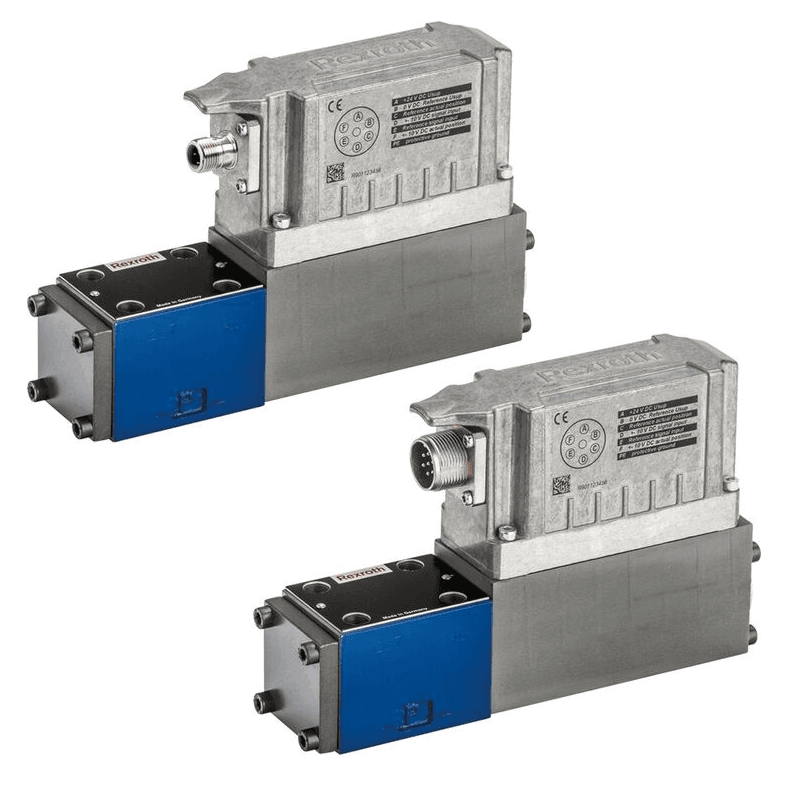
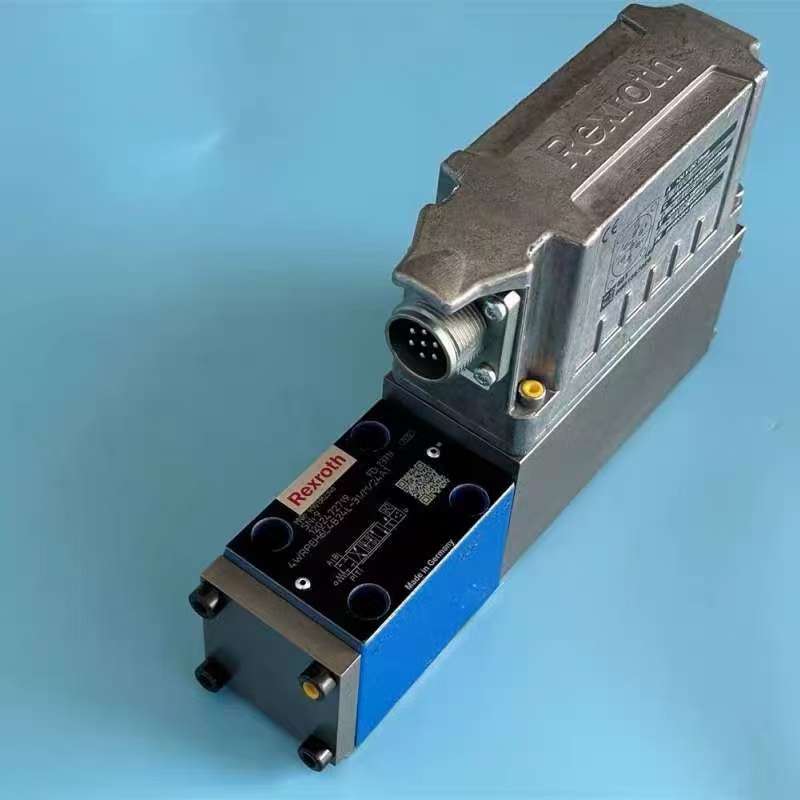
Many include a position sensor (LVDT) on the spool, which closes the loop and turns the unit into a servoproportional. The valve shown here is a Bosch Rexroth 4WRPEH, one of the more common servoproportionals we see on the bench.
️🛡️A Solenoid-Driven Hydraulic Valve: Two Main Forms
Proportional valves come in two main forms: standard proportional (open-loop) and servoproportional (closed-loop with spool-position feedback). Most of what comes through the bench is one or the other, and the bench work overlaps but is not identical.
1️⃣ Standard Proportional (Open-Loop)
This is the simpler pattern. A pair of large coils on each end of the spool produces a magnetic force that pushes the spool against centering springs. The spool position is roughly proportional to the input current.
- Feedback: No internal position feedback; if the spool is fighting a load, the position can drift.
- Performance: Bandwidth is modest (often < 50 Hz), but flow capacity is higher than a servo valve and the tolerance for dirty oil is better.
- Common Models:
- Atos: DHZO, DKZOR (without transducer)
- Bosch Rexroth: 4WRA
- Yuken: EFBG
2️⃣ Servoproportional (Closed-Loop)
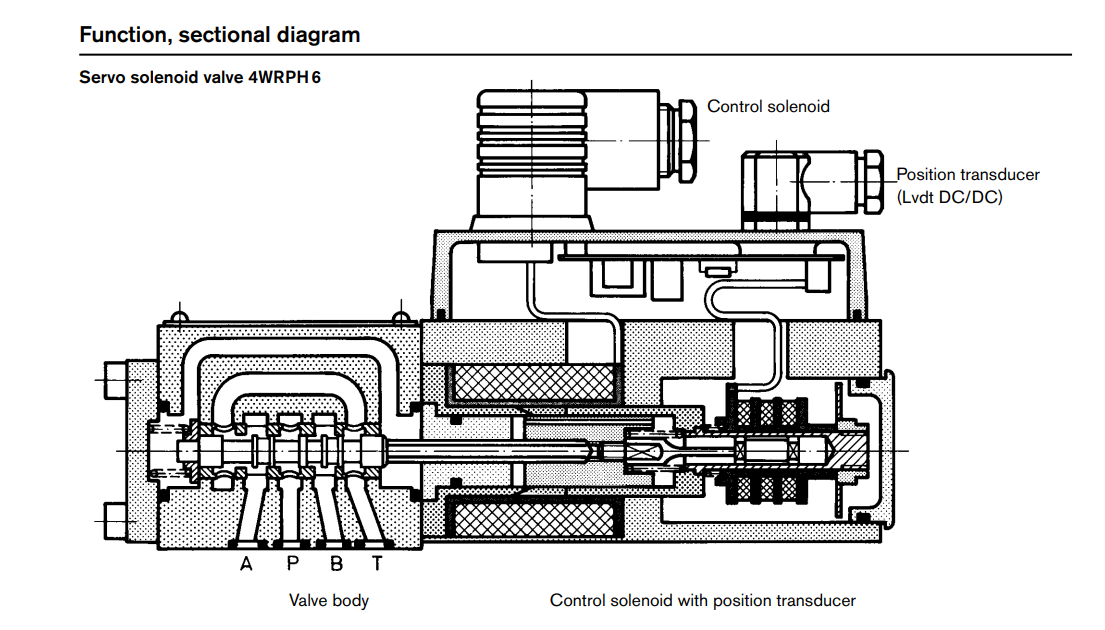
This type adds an LVDT (linear variable differential transformer) that measures actual spool position and feeds it back to onboard or external electronics. The drive electronics adjust coil current continuously to push the spool to the commanded position, even under load.
- Feedback: Continuous position feedback
- Performance: Bandwidth is higher than a standard proportional, deadband is smaller, and accuracy is better.
- Common Models:
- Atos: DLHZO, DLKZOR
- Bosch Rexroth: 4WRPH, 4WRPEH, 4WREE
- Yuken: EHFBG
- Duplomatic: DXE
⚡Shared Skeleton & Bench Work
Both types share the same core anatomy:
- A body bore with a spool inside
- Two solenoid coils on each end
- Centering springs
- Four hydraulic ports
- (On servoproportional variants) An LVDT and either an external driver card or onboard electronics (OBE)
Bench Work Note:
The differences are in the feedback loop and the accuracy of the spool fit. However, bench work overlaps a lot. A burned coil is a burned coil. A worn spool is a worn spool. The differences primarily show up in the LVDT and OBE channels on servoproportionals (which do not exist on the standard variants).

Reviews
There are no reviews yet.